Long-term memory
Written By Stanislas
Last updated 16 days ago
Overview
Long-term memory allows your Swiftask agent to retain relevant context and information across different conversation sessions. Instead of starting from scratch every time you open a new chat, the agent remembers key details from past interactions.
This solves context loss across sessions and eliminates the need to repeatedly provide background information. Use long-term memory when building agents that assist with recurring workflows, personalized coaching, customer support, or complex ongoing projects.
Understanding Agent memory vs. User memory
Swiftask provides two distinct types of long-term memory:
Agent memory (scoped to a single agent): Retains what this specific agent learns during interactions. The stored context stays strictly within this agent and is never shared with other agents. For example, if you tell a Customer Support agent "I prefer receiving concise bullet-point summaries," this agent remembers your formatting preference, while your Code Assistant agent will not know about it.
User memory (shared across all agents): Retains user-level preferences, role details, and personal context across your entire account. Any agent with User memory enabled can access this shared context. For example, if you tell one agent "I work as a marketing director based in Paris," all other agents with User memory enabled will automatically know your role and location without asking again.
Prerequisites
Before configuring long-term memory, verify the following:
You have an active Swiftask account.
You own the agent or have edit permissions for it.
The agent is unlocked if agent locking is enabled.
Step-by-step guide
1. Access Long term memory settings
Open your agent from the Agents menu.
Select the Manual setup tab at the top of the configuration screen.
In the left navigation bar, expand Agent Instruction and click Long term memory.
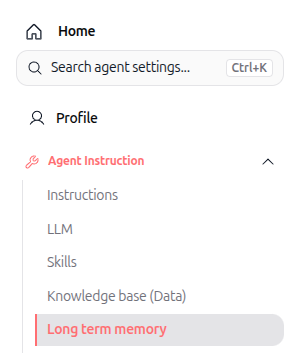
2. Configure and activate memory types
The Memory configuration page provides independent toggles and instruction helpers for both memory types.
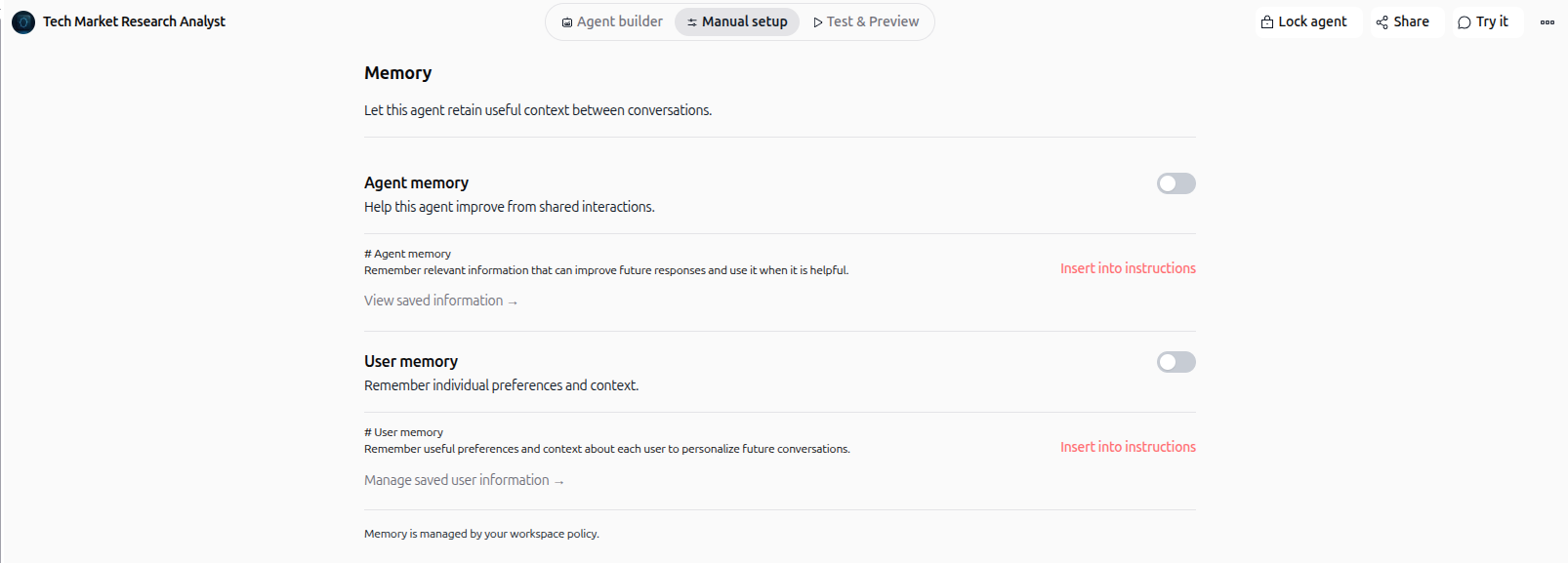
Under Agent memory, turn the toggle switch ON to allow the agent to store and recall agent-specific context.
Click Insert into instructions next to the
# Agent memorycard to append behavioral directives directly into your agent's system instructions.Under User memory, turn the toggle switch ON to allow the agent to read and save profile-wide user preferences.
Click Insert into instructions next to the
# User memorycard to inject user-personalization guidelines into your agent's instructions.
Important: The Insert into instructions button inserts the guiding prompt text into the agent's instructions, but it does not activate memory by itself. You must switch the toggle to ON for the agent to actively save and retrieve memory entries.
3. View and manage saved Agent memory
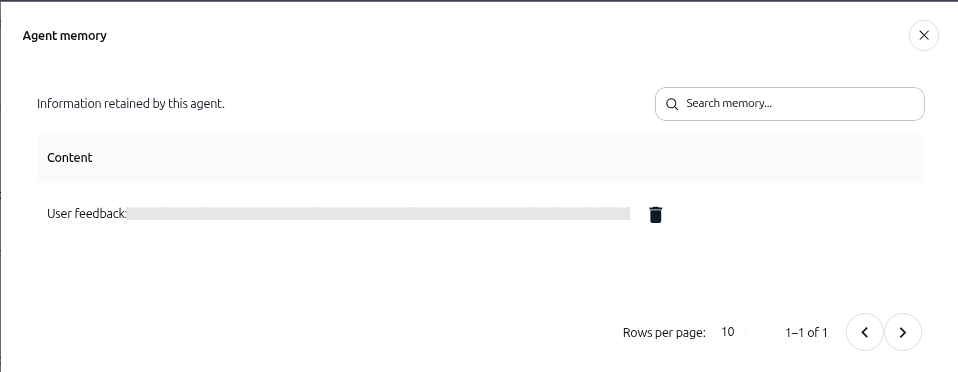
Click View saved information → under the Agent memory section.
Review the list of items retained by this agent.
Use the Search memory… field to find specific entries.
Click the trash icon next to any entry to remove it permanently.
4. View and manage saved User memory
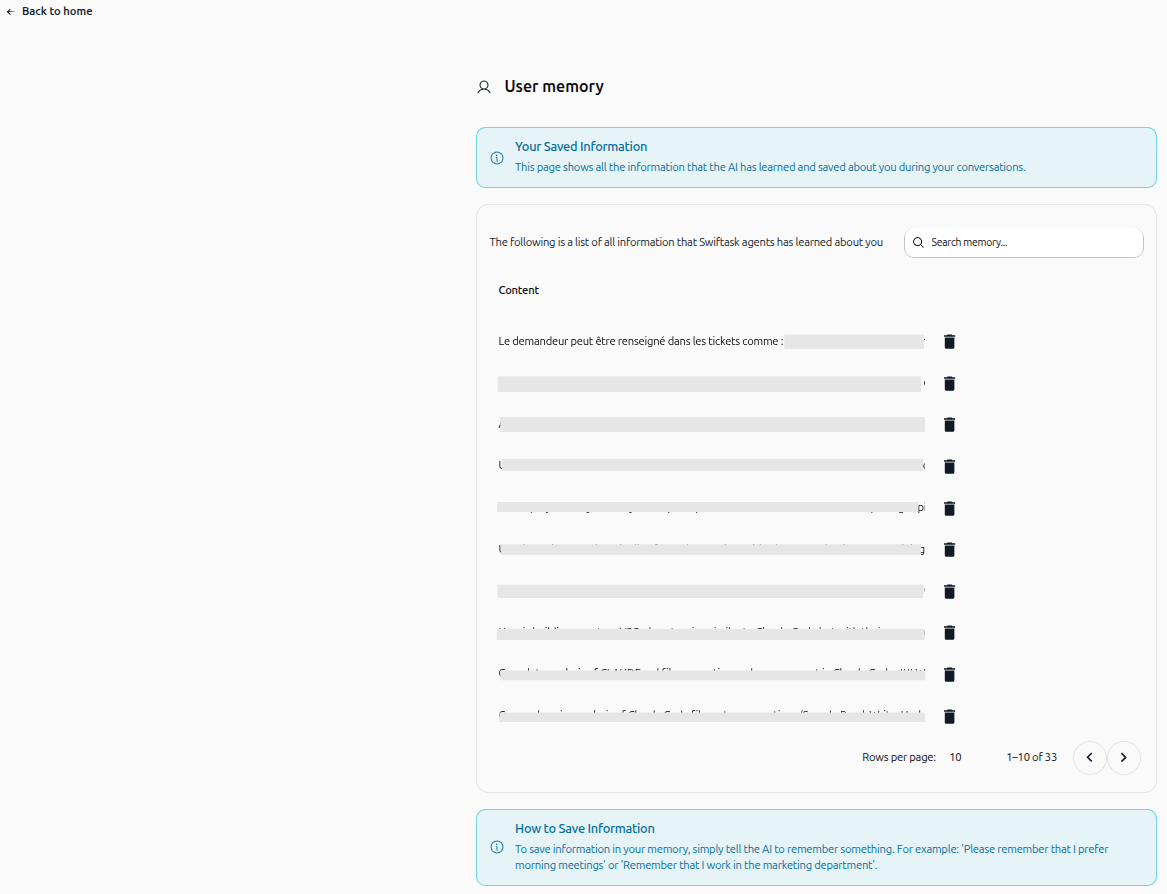
Click Manage saved user information → under the User memory section.
Browse all preferences and profile details learned by Swiftask agents across your account.
Use the search bar to locate specific information, or click the trash icon to delete outdated records.
5. Verify memory in chat
When interacting with an agent that has memory enabled, the agent autonomously retrieves and writes context during its execution using Agent Memory Tools.

Practical use cases
Dedicated project assistant (Agent memory)
Configure an agent dedicated to managing a specific company initiative. With Agent memory enabled, the agent remembers milestone dates, internal document codes, and project revisions without polluting your general profile or confusing other bots.
Workspace onboarding assistant (User memory)
Enable User memory on your primary workspace agents. Once you tell your first agent your job title, team department, and working hours, every other connected agent personalizes its answers accordingly without requiring you to reintroduce yourself.
Technical code reviewer (Dual memory)
Activate User memory so the agent knows your preferred programming languages and editor settings. Activate Agent memory so the agent remembers project-specific architectural rules and past code review feedback for that repository.
Tips & best practices
Activate the toggle after inserting instructions: Always ensure the toggle switch is set to ON after clicking Insert into instructions.
Clean up periodically: Check your saved memories every few weeks to delete temporary project details or outdated guidelines.
Be explicit in conversations: You can instruct the agent directly in chat by saying, "Please remember that our team uses Jira for issue tracking."
Review workspace policies: Memory retention is subject to workspace data governance policies set by your administrators.
Troubleshooting
The agent does not remember past conversation context
Cause: The memory toggle is switched OFF, even though instructions were inserted.
Fix: Go to Agent Instruction → Long term memory and ensure the toggle next to Agent memory or User memory is turned ON.
The agent inserted duplicate memory directives
Cause: The Insert into instructions button was clicked multiple times or custom instructions already existed.
Fix: Open Agent Instruction → Instructions, locate the duplicate
# Agent memoryor# User memoryheaders, and remove redundant lines.
An agent uses outdated personal information
Cause: Old preferences remain stored in the memory database.
Fix: Click Manage saved user information → (or View saved information → for agent memory), search for the outdated entry, and click the trash icon to delete it.
Additional resources
Agent instructions settings – Learn how to configure your agent's system prompt and behavioral guidelines.
Agent profile – Configure your agent's display name, description, and avatar.
Model selection – Choose the best LLM model to power your agent's reasoning and memory capabilities.
Was this helpful?
Still need help? Ask the team