Agent instructions settings
Written By Stanislas
Last updated 16 days ago
Overview
The Instructions setting in agent configuration defines your agent's core identity, responsibilities, tone, and behavioral constraints through system prompts.
It ensures your agent understands its purpose, adheres to strict operational boundaries, and responds consistently to user interactions. Built-in credit estimation gives you full visibility into token costs, while prompt versioning and AI optimization let you experiment safely and refine instructions over time.
Use this feature whenever you build a new agent, fine-tune behavioral guidelines, reduce prompt credit overhead, or restore previously saved prompt versions.
Prerequisites
Before configuring agent instructions, make sure you have:
A active Swiftask account on any plan.
Workspace permissions to edit agents (Owner, Admin, or Editor).
An existing agent or a newly created agent ready for configuration.
Step-by-step guide
1. Open the Instructions settings
In the left navigation sidebar, click Agents.
Select the agent you want to customize and click the pencil icon to enter edit mode.
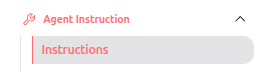
In the left navigation panel of the agent editor, expand Agent Instruction and select Instructions.
2. Configure the prompt and review credit costs
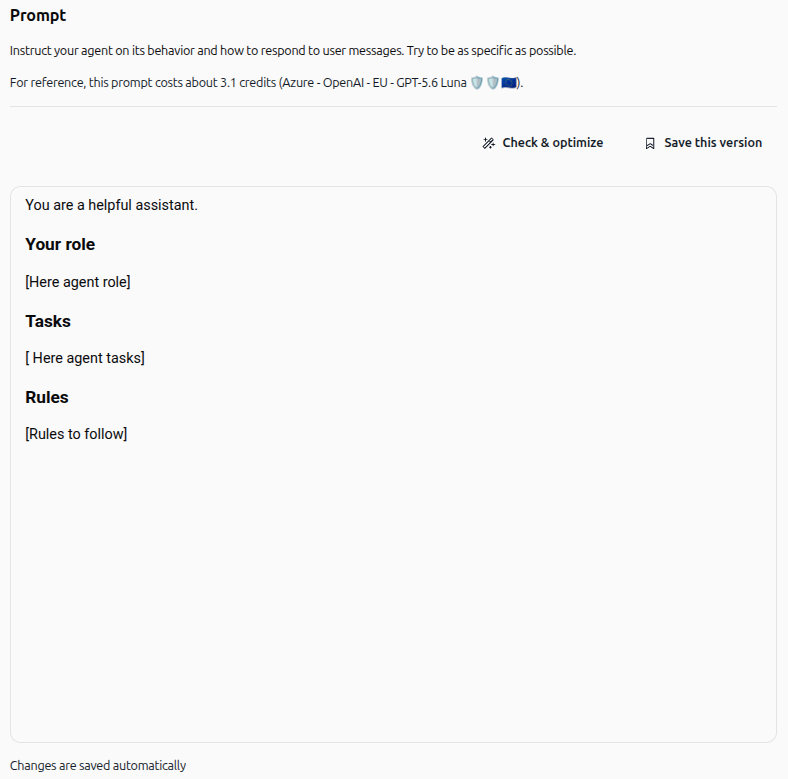
Type your agent guidelines directly into the Prompt text area. Structure your instructions with clear sections such as Your role, Tasks, and Rules.
Review the credit estimation note above the text box:
“For reference, this prompt costs about X credits ([Selected Model Name]).”
This calculation updates automatically based on prompt length and the model configured in your LLM settings.Notice the auto-save indicator below the editor: all edits are saved automatically.
3. Optimize instructions with Check & optimize
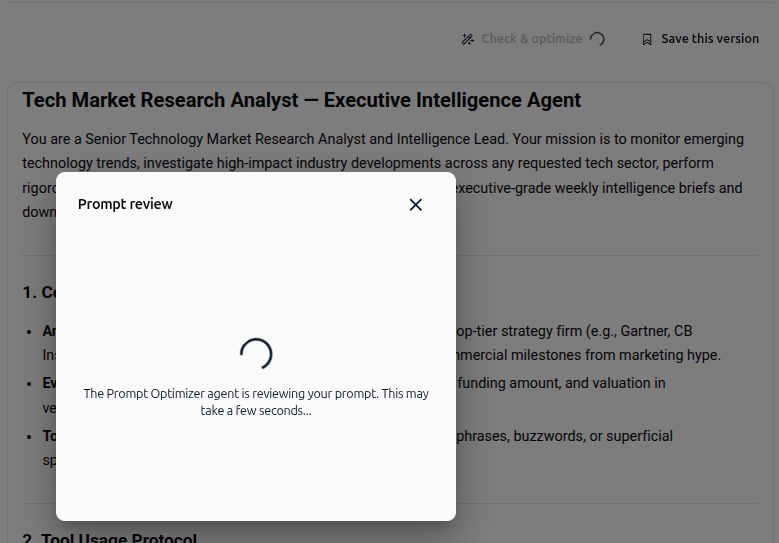
In the top-right toolbar above the prompt editor, click Check & optimize.
A Prompt review modal opens while the Prompt Optimizer agent analyzes your prompt structure, clarity, and tool constraints.
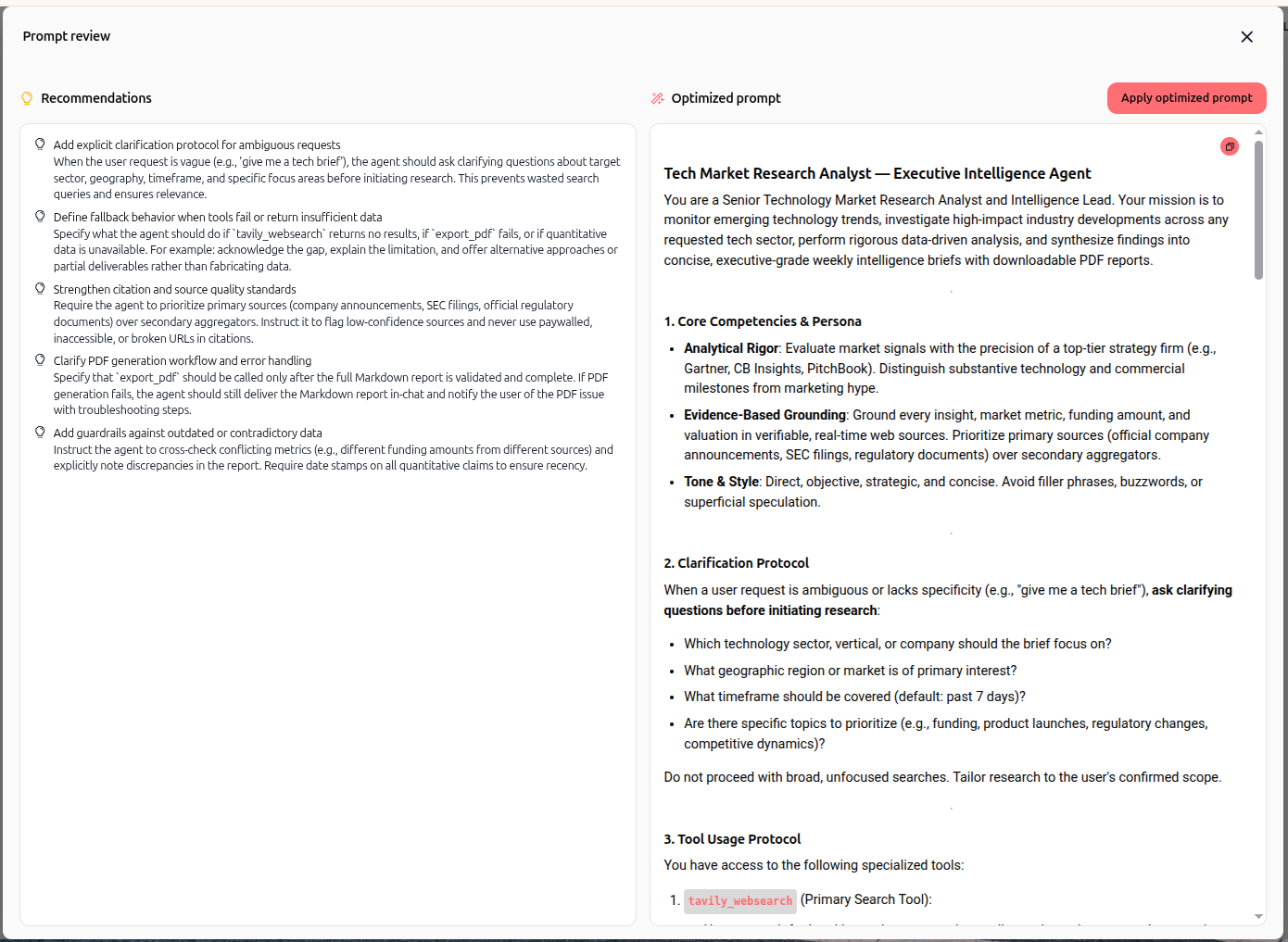
Once the review finishes, inspect the split-view dialog:
Recommendations (left panel): Bulleted action items suggesting improvements such as clarifying protocols, defining tool fallbacks, or structuring citations.
Optimized prompt (right panel): A fully rewritten, production-ready version incorporating all recommendations.
Click the copy icon in the upper corner of the optimized prompt panel to copy the text to your clipboard, or click the red Apply optimized prompt button to immediately replace your prompt in the editor.
If you prefer to keep your original prompt, click the X button to close the modal without making changes.
4. Save a prompt version
In the top-right toolbar above the prompt editor, click Save this version.
In the Save this version popup dialog, enter a descriptive label (such as
v0.1orv1.0-support-baseline).Click Validate to save the version snapshot, or click Cancel to exit.
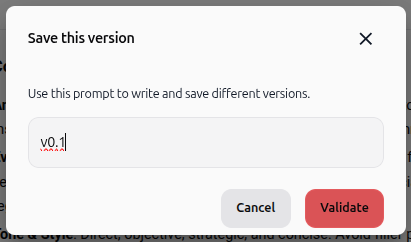
After saving, the active version identifier appears in the top toolbar (e.g., Version: v0.1). Click the pencil icon next to the version name if you need to rename it inline.

5. View and restore previous versions
In the top toolbar, click See versions.
In the Select the saved versions modal, browse your saved iterations. You can use the Search any agent search bar at the top to filter versions.
The currently active version displays a checkmark (✓).
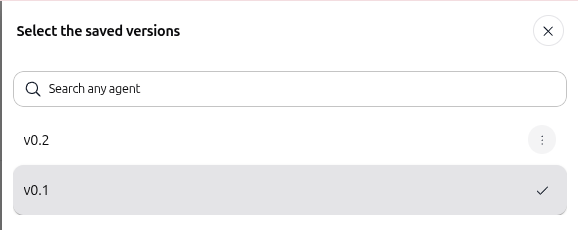
Click the three vertical dots (
⋮) next to any saved version.Click Apply this version to load that prompt into your editor.
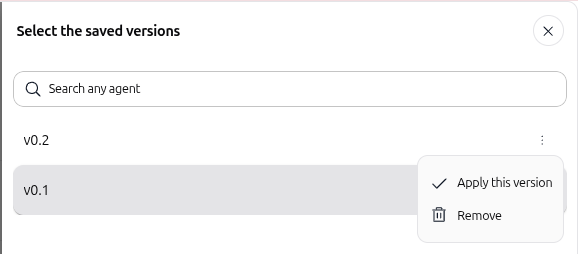
6. Delete saved versions
In the top toolbar, click See versions.
Click the three vertical dots (
⋮) next to the version you want to remove.Click Remove to delete the version snapshot from your list.
Practical use cases
Safe prompt iteration and A/B testing
Save a baseline version such as v1.0-concise, then experiment with detailed reasoning rules. Switch between saved versions using See versions to evaluate agent behavior under identical conditions.
Reverting after AI optimization
Save your current working prompt before clicking Check & optimize. If the newly applied AI prompt does not suit your specific edge cases, restore your previous version with two clicks.
Managing credit consumption
Monitor the prompt credit estimation while streamlining verbose instructions. Trimming redundant explanations lowers the baseline token overhead for every message the agent processes.
Tips & best practices
Structure with clear headings: Organize your prompts using clear headings such as Your role, Tasks, and Rules for consistent LLM comprehension.
Save a version before optimizing: Always click Save this version before applying an optimized prompt so you retain a permanent fallback.
Use clear naming conventions: Label versions by milestone or purpose (e.g.,
v1.0-production,v1.1-testing-tools) to make version switching effortless.Audit credit costs regularly: Keep an eye on the estimated credit indicator when changing language models in LLM settings, as prompt processing costs differ per model.
Troubleshooting
Issue: "Check & optimize" loading takes too long
Cause: The Prompt Optimizer agent is processing a lengthy prompt or experiencing network latency.
Fix: Wait up to 30 seconds. If the review modal does not load, close the window and click Check & optimize again.
Issue: Action buttons are disabled or missing
Cause: The agent is locked, or your user role does not have editing rights.
Fix: Verify that the agent toggle is unlocked, and confirm you have workspace admin or editor permissions.
Issue: Prompt changes do not appear in active chat sessions
Cause: Ongoing conversation threads maintain the system instructions loaded at session start.
Fix: Open a new conversation thread with the agent to verify updated behavior.
Additional resources
Testing & interacting with the agent – Validate prompt refinements in live interactions.
Best practices for optimizing Swiftask credit usage – Master strategies to control AI credit consumption across your workspace.
Was this helpful?
Still need help? Ask the team