Use Knowledge
Written By Stanislas
Last updated 16 days ago
Overview
Knowledge lets you bring your stored documents, folders, and data sources directly into your daily work. Instead of manually searching for information, you can access it wherever you need it — in a conversation, through an AI agent, or shared across a project team.
This article explains how to use Knowledge in three contexts: Chat, Agent, and Project. Each context gives you a different way to put your knowledge to work.
Prerequisites
Before using Knowledge in any of these contexts, you need:
A Swiftask account (sign up at swiftask.ai)
At least one document, folder, or data source already added to Knowledge
For Agents: permission to create or edit agents in your workspace
For Projects: access to the project where you want to attach knowledge
Step-by-step guide
Using Knowledge in Chat
Chat gives you two ways to work with Knowledge: attaching a source to a conversation, or chatting directly inside the Knowledge section itself.
Attach knowledge to a Chat conversation
Open Chat in the left sidebar.
In the message input toolbar, click the book icon (next to the settings/sliders icon).
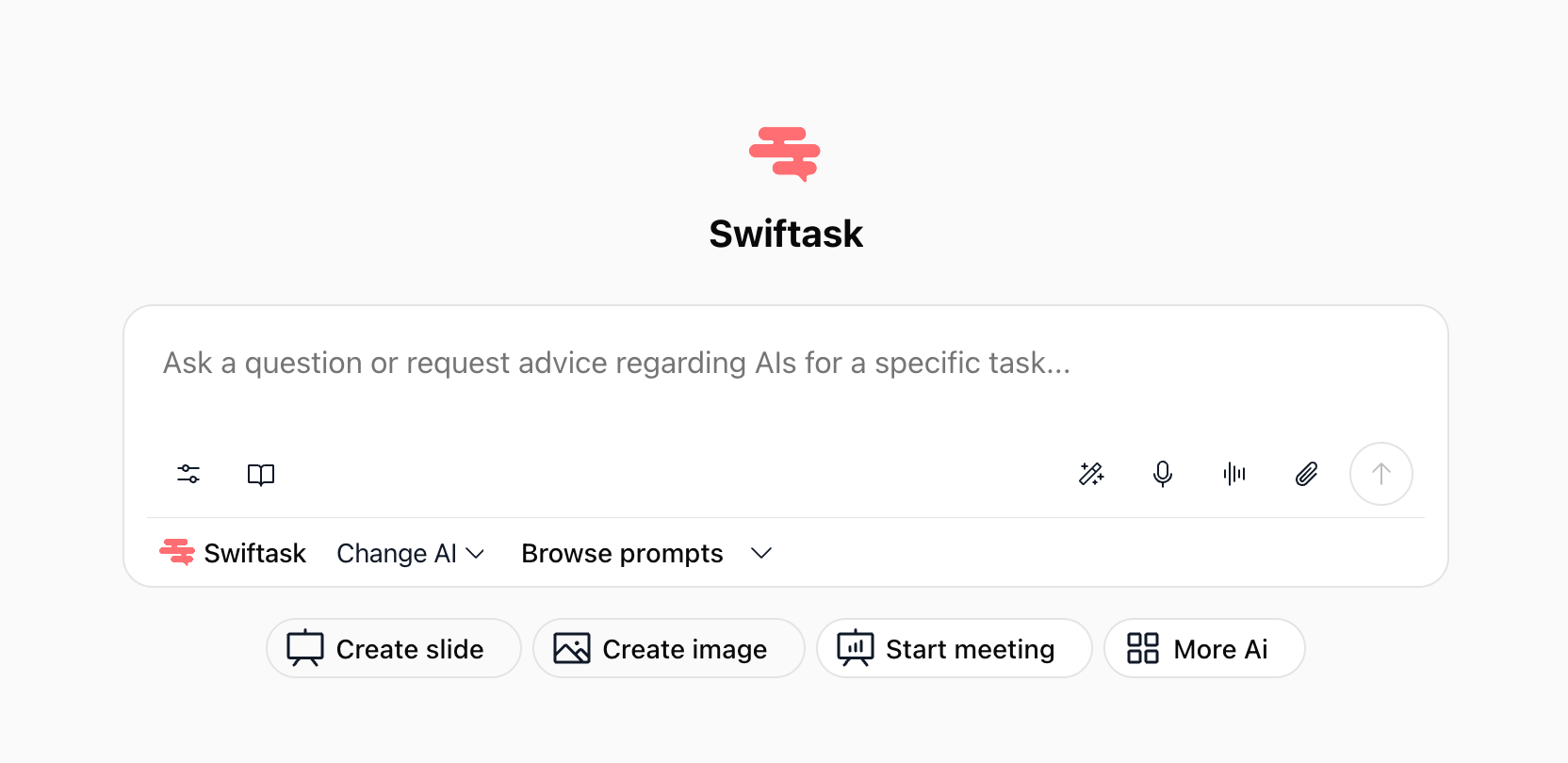
The Select knowledge sources panel opens. This grounds the AI's answers on your selected knowledge and includes citations when possible — no agent setup required. You can remove sources at any time.
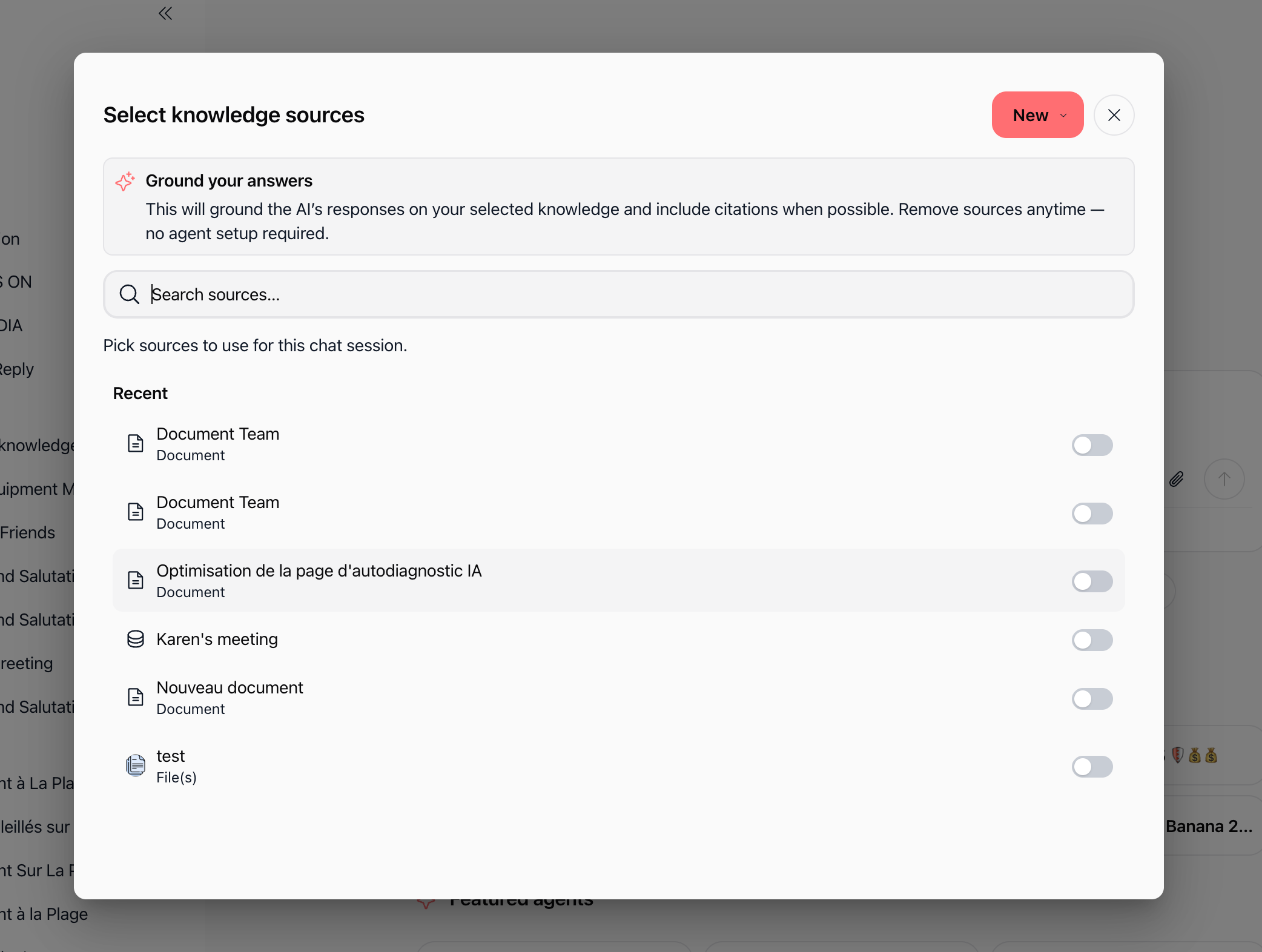
Use Search sources… to find a specific document, or pick one from the Recent list.
Toggle on each source you want to use for this chat session. You can select documents, files, or full data sources.
Close the panel and ask your question. The AI answers using the attached knowledge and cites sources when possible.
Chat directly from the Knowledge section
You don't need to leave Knowledge to ask questions. An AI chat bar is built into the Knowledge interface itself, and it adapts to where you are:
At the Knowledge home level – Ask questions about your entire knowledge base (all folders and documents) using the message bar at the bottom of the screen ("Ask questions about your knowledge, or ask to edit a document…").
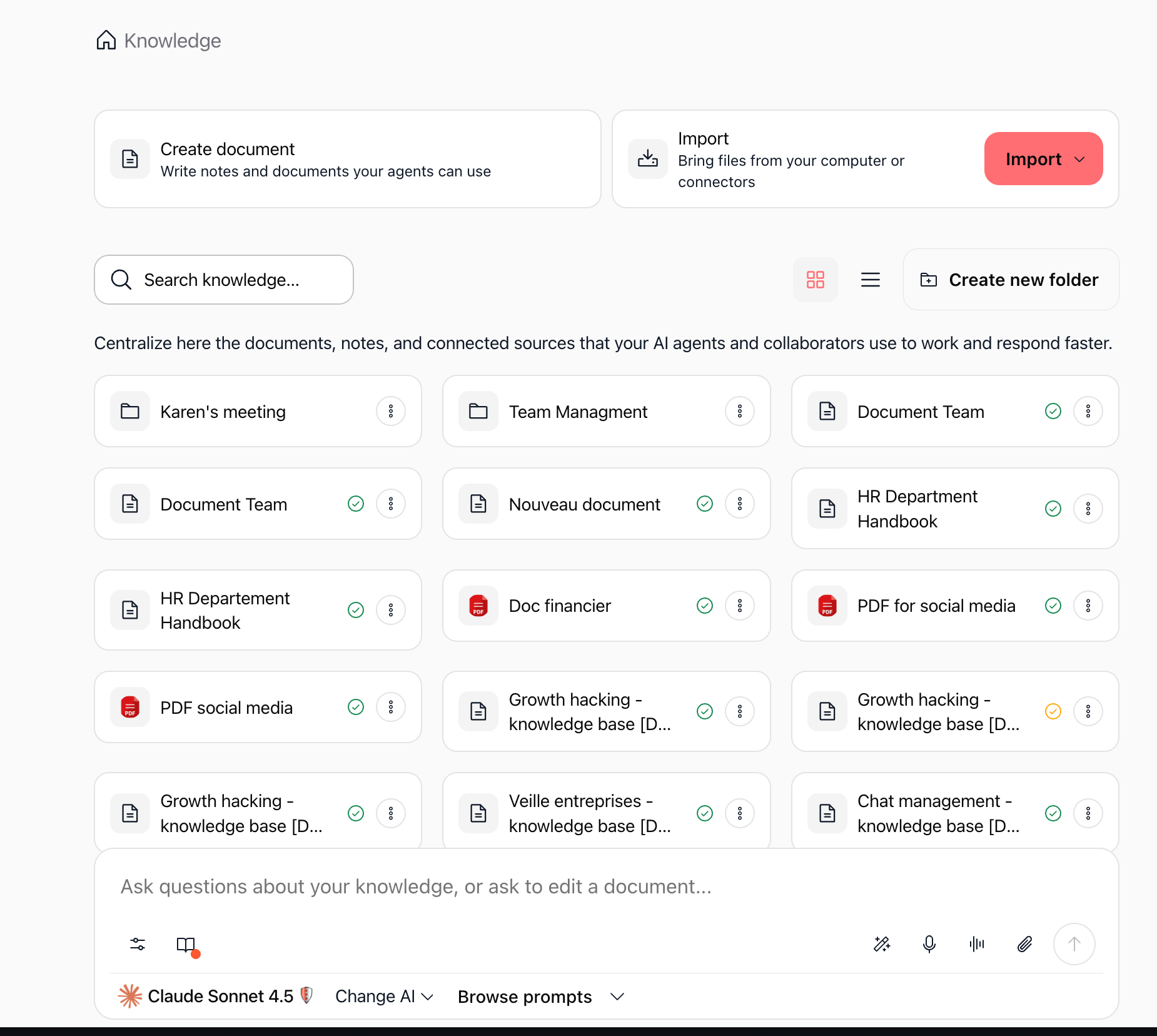
Inside a folder – Narrow your questions to the documents contained in that folder.
Inside a specific document – The chat bar becomes context-aware: it knows which document you're viewing and can answer questions about it, or edit its content directly on your request.
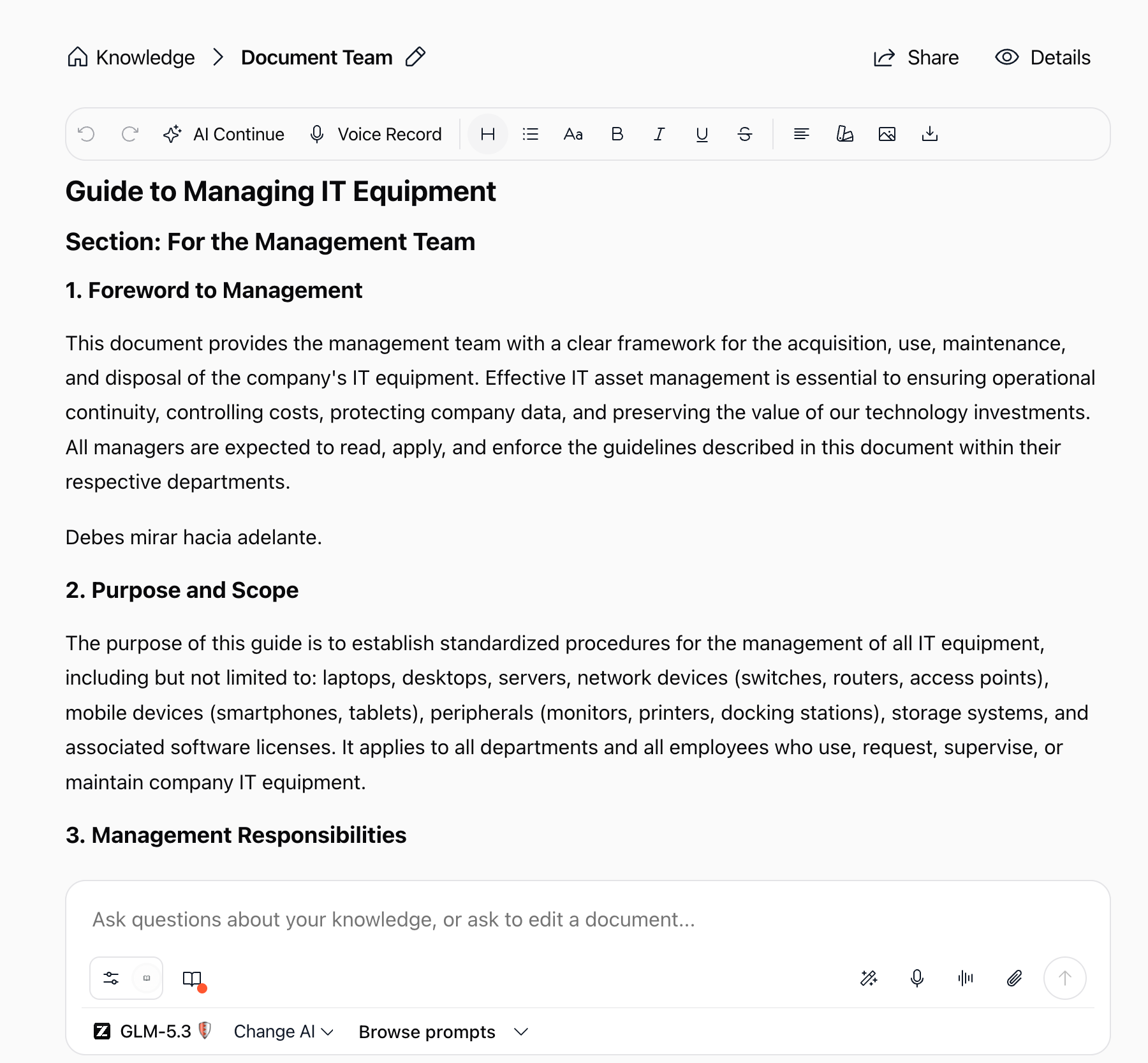
Choose the AI model you want to use via Change AI, or use Browse prompts for ready-made prompts.
This means you can simplify access to information: chat with the general knowledge base, a folder, a single document, or even specific file details — all from the same interface.
Edit a document via chat
While viewing a document, you can also ask the AI to modify its content instead of editing it manually.
Open the document in Knowledge.
Type your request in the chat bar at the bottom of the document (e.g., "Rewrite section 3 in a more formal tone" or "Add a summary at the top").
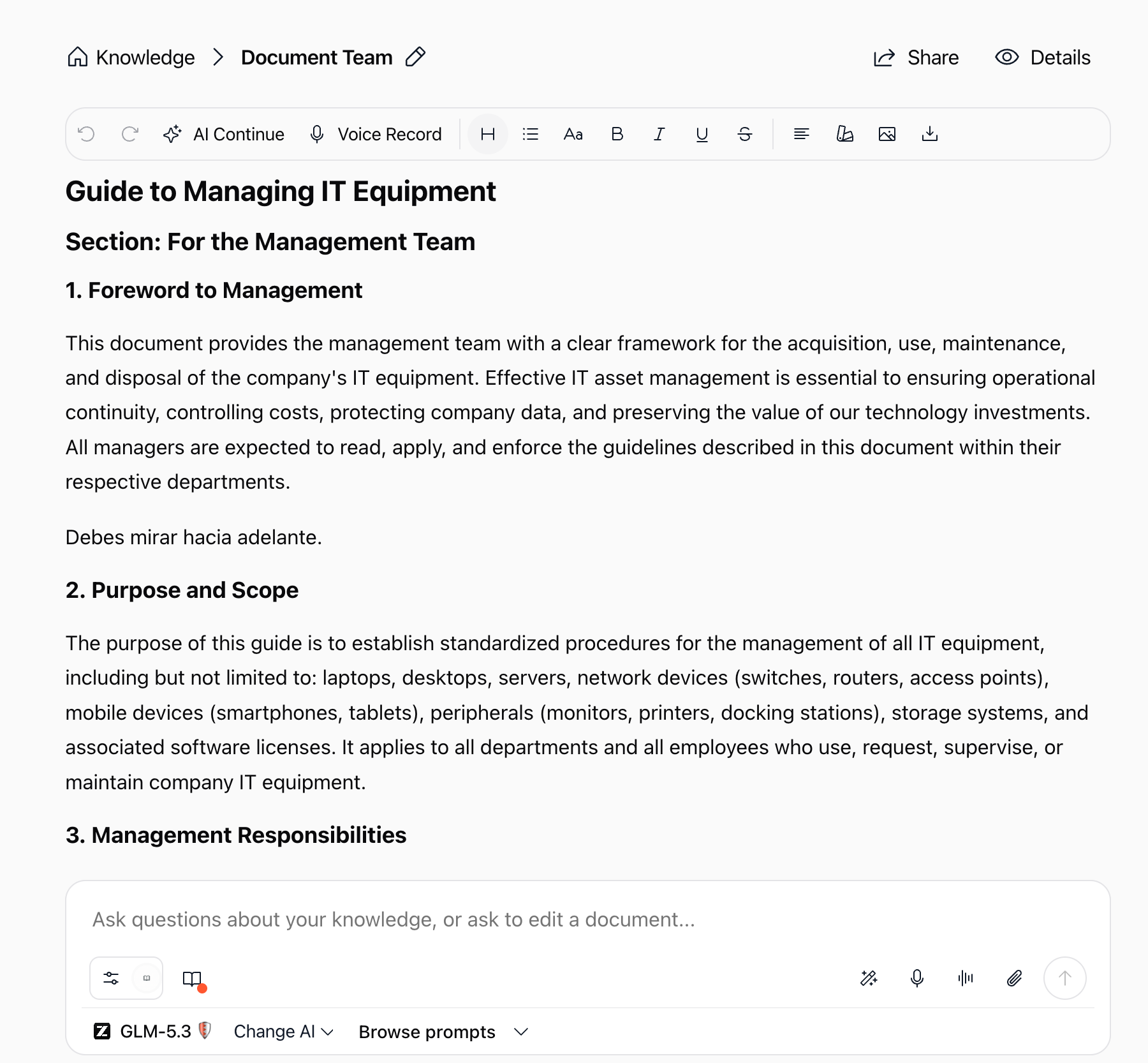
Review the AI's changes directly in the document editor above the chat bar.
Using Knowledge in Agent
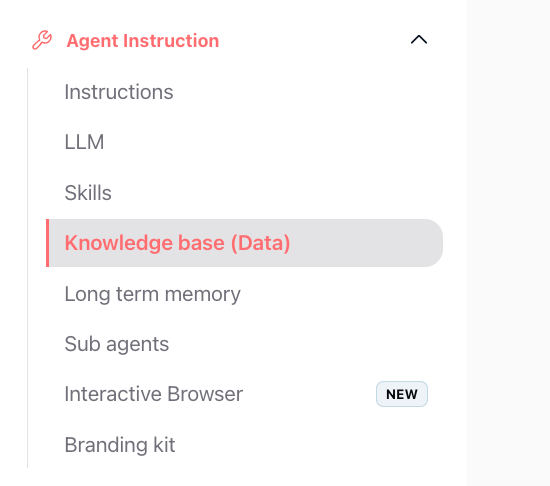
Open your agent's settings and go to the Knowledge base (Data) section in the left sidebar of the configuration screen.
Choose how to add content:
Import files – Upload PDF, DOCX, XLSX, CSV, and other formats.
Create document – Write an internal note or guide directly in Swiftask.
Web content – Import webpages, websites, or sitemaps.
Cloud connectors – Sync content from SharePoint, Google Drive, or Dropbox.
Workspace knowledge – Reuse existing data sources already in your workspace.
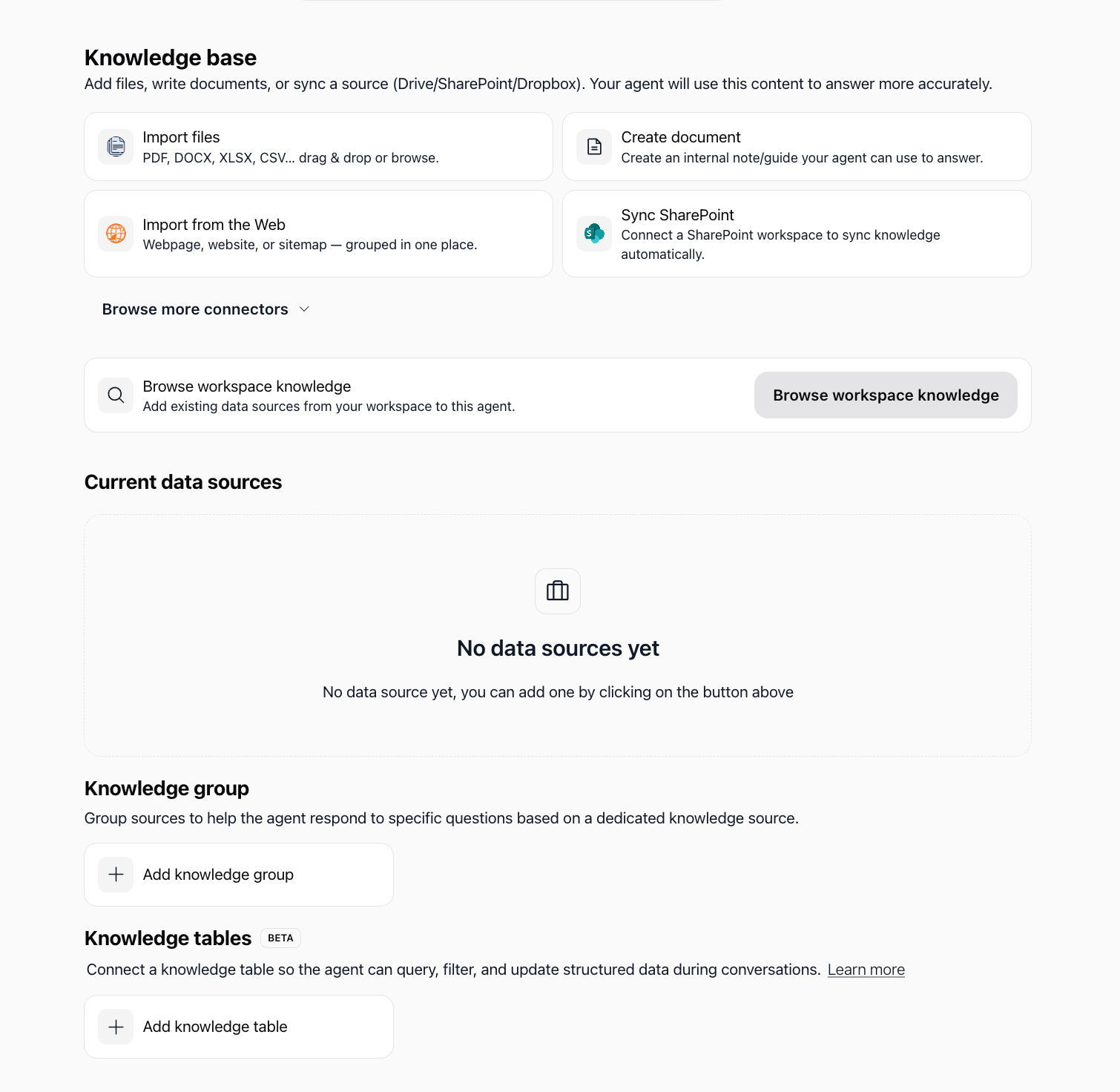
Save your configuration. The agent immediately starts using this content.
Test your agent using the test panel to confirm it references the correct information.
Click Use this agent to start using it in Chat.
Once connected, the agent searches the attached knowledge whenever a user asks a question, and references the most relevant content in its response.
Using Knowledge in Project
Open your project and go to Project settings → Knowledge → Add knowledge sources.
Select the documents, folders, or data sources you want to attach to the project.
Save your selection.
Every chat within that project automatically has access to the same centralized knowledge. Team members don't need to manually add knowledge to each individual chat — it's shared by default across the whole project.
Practical use cases
Quick document Q&A in Chat
Click the book icon, select your quarterly report from Recent, then ask "Summarize the key risks mentioned in this report." Get an instant, context-aware, cited answer without leaving Chat.
Rewriting a policy document without leaving Knowledge
Open your HR handbook in Knowledge and ask the built-in chat bar to "Simplify the parental leave section for a general audience." Review and accept the AI's edits directly in the document.
Specialized support agent
Connect your product documentation and FAQs to an agent's Knowledge base (Data) section. The agent then answers customer questions using only your verified, up-to-date content.
Shared context for a project team
Attach your onboarding guide and process documents to a project via Project settings → Knowledge. Every team member's chat in that project can reference the same materials automatically.
Tips & best practices
Use attachments for one-off questions, Knowledge base for recurring ones. If a document is only relevant to a single conversation, attach it via the book icon in Chat. If it will be reused often, add it to Knowledge instead.
Keep documents focused. Smaller, well-structured documents are easier for the AI to search and reference accurately.
Review AI edits before saving. When asking the chat to modify a document, check the changes to make sure they match your intent.
Attach knowledge at the project level for team consistency. This avoids team members working from outdated or mismatched information.
Troubleshooting
The AI can't find information even though it's in Knowledge
Check that the document status shows "Indexed and ready." If it's still processing, wait a moment and try again.
Chat answers seem outdated
Knowledge integration is real-time, but if an agent still returns old information, verify the source document was actually saved after your latest edit.
Project members don't see the shared knowledge
Confirm the knowledge source was added under Project settings → Knowledge → Add knowledge sources, not just attached to a single chat.
Additional resources
Introduction to Knowledge base – Learn what Knowledge base is and why it matters
Sources (Knowledge base) – Connect documents and data to your agent
Using agents from Chat – Invoke specialized AI agents directly from Chat
Building projects – Collaborate with your team on structured workflows
Was this helpful?
Still need help? Ask the team