Introduction to Knowledge base
Written By Stanislas
Last updated 16 days ago
Overview
Knowledge base is your centralized repository in Swiftask for storing and structuring unstructured documents, web pages, and database tables. It eliminates scattered files across teams and gives both your colleagues and AI agents a single source of truth.
Connecting a knowledge source to an AI agent allows it to pull accurate, cited context during conversations rather than relying solely on general training data. Once added, resources are reusable across Chat, AI Agents, and Projects.
What you can store:- Documents uploaded directly to Swiftask (PDFs, Word files, spreadsheets, etc.)- Web content imported from websites and web pages- Files synced from cloud storage (Google Drive, SharePoint, Dropbox)- Notes and documents created directly in Swiftask- External data sources (databases, APIs)
How it works:Knowledge base organizes your content into data sources (also called datasources). Each data source is a collection of related documents or information. You can connect one or multiple data sources to an agent, giving that agent access to specific information it needs to do its job.
When we should use Knowledge base
Use Knowledge base when you want:- Centralized access: Keep company handbooks, guidelines, and documentation accessible to entire teams and multiple AI agents simultaneously.- Persistent context: Maintain evergreen resources that update dynamically across all connected conversations and agents when edited.- Structured navigation: Organize multiple resources into folder trees, sub-folders, or structured Knowledge tables.
Use direct Chat attachments instead when:- You only need a one-off summary of a single temporary file.- The document is private to a single conversation and will not be reused by other agents or team members.
Prerequisites
Before configuring your Knowledge base, ensure you have:- An active Swiftask account (sign up at swiftask.ai).- Access to the Knowledge section in the left navigation sidebar.- Permission to create and manage data sources in your workspace (configured by a workspace Admin or Owner).
Step-by-step guide
1. Access the Knowledge section
Click Knowledge in the primary left navigation sidebar. The main Knowledge interface opens, showing your top-level data sources, folders, and management tools.
2. Navigate using the permanent sidebar folder tree
The permanent sidebar on the left side of the Knowledge interface provides dedicated navigation across your resources.
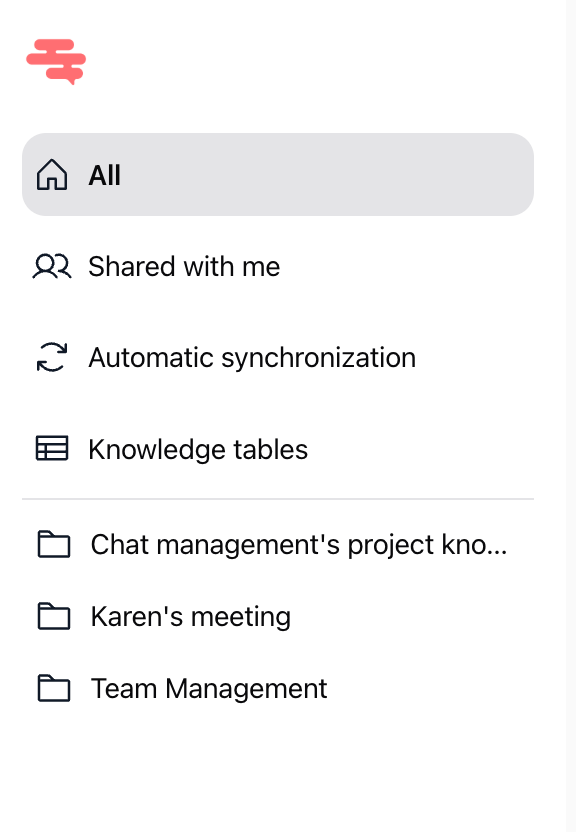
The tree contains standard system categories and custom workspace folders:- All: Displays all documents, files, and folders across your workspace.- Shared with me: Filters for knowledge sources and folders explicitly shared with your account.- Automatic synchronization: Opens the dashboard to track scheduled cloud storage syncs.- Knowledge tables: Direct access to structured database tables and schemas.- Workspace folders: Custom folders (such as Chat management's project knowledge, Karen's meeting, or Team Management) listed below the divider line for instant access.
3. Organize and switch display views
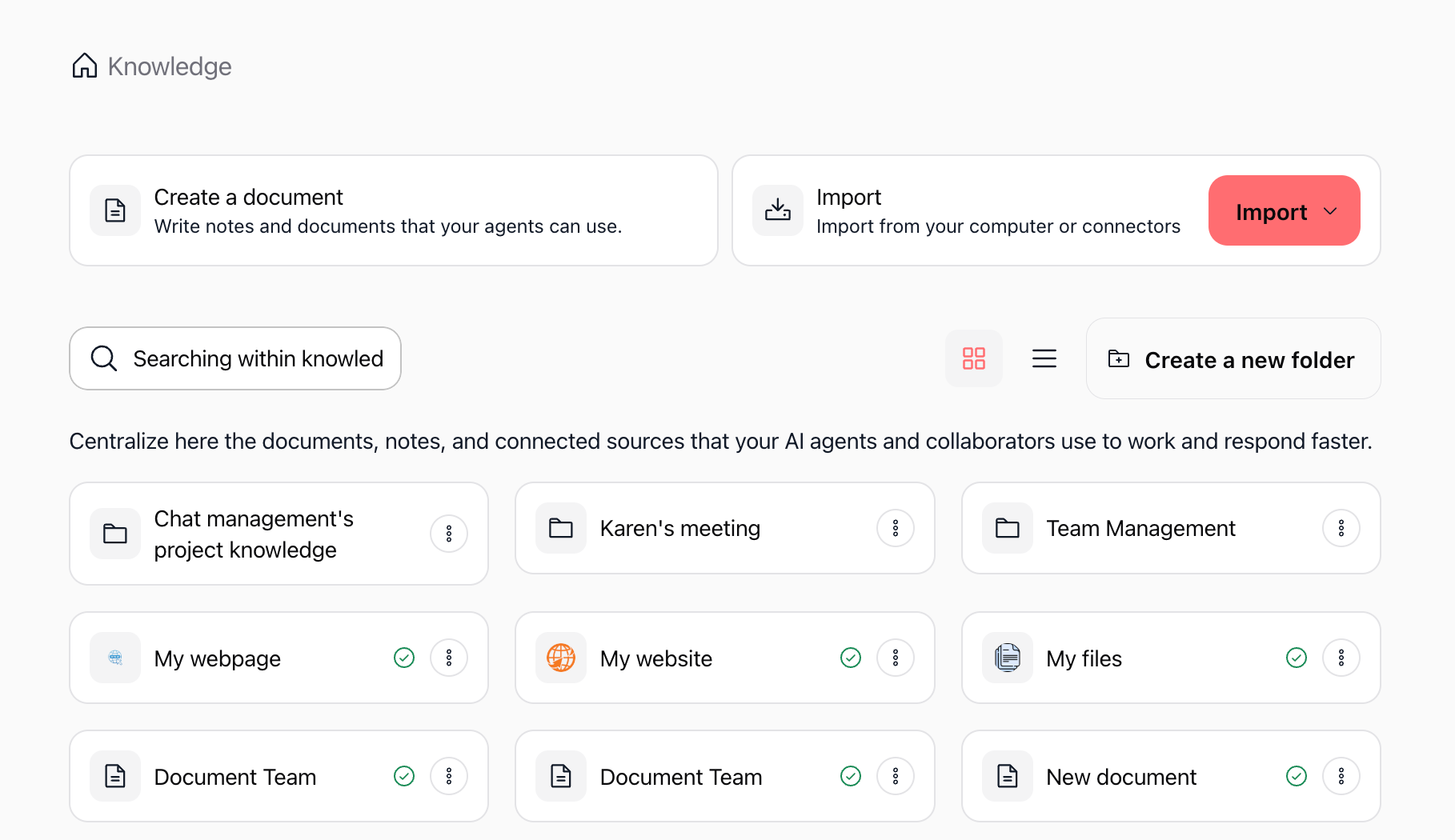
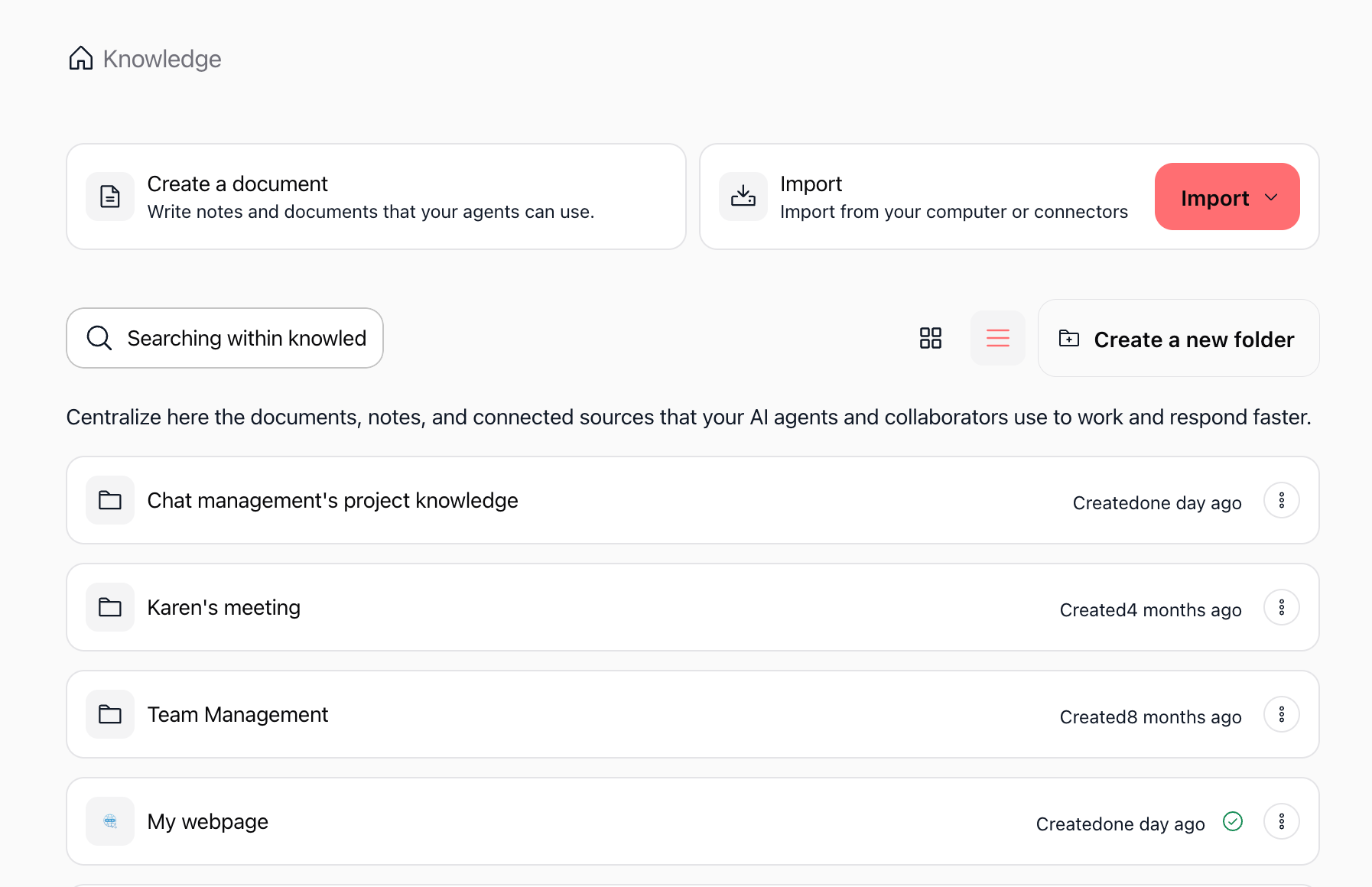
You can toggle between Card view and List view using the view selector icons in the top-right toolbar next to the Create a new folder button.
Card view
Card view displays your folders and documents as visual tiles across a grid layout. Each card presents an icon representing the item type (folder, document, webpage, file), its name, indexation status, and a three-dot action menu (⋯).
List view
List view organizes your knowledge base items into compact rows. This view makes it easy to scan through large volumes of documents and folders quickly.
4. Search knowledge
You can search across your entire knowledge base to quickly locate specific folders, files, and documents.
Opening search and viewing recent items
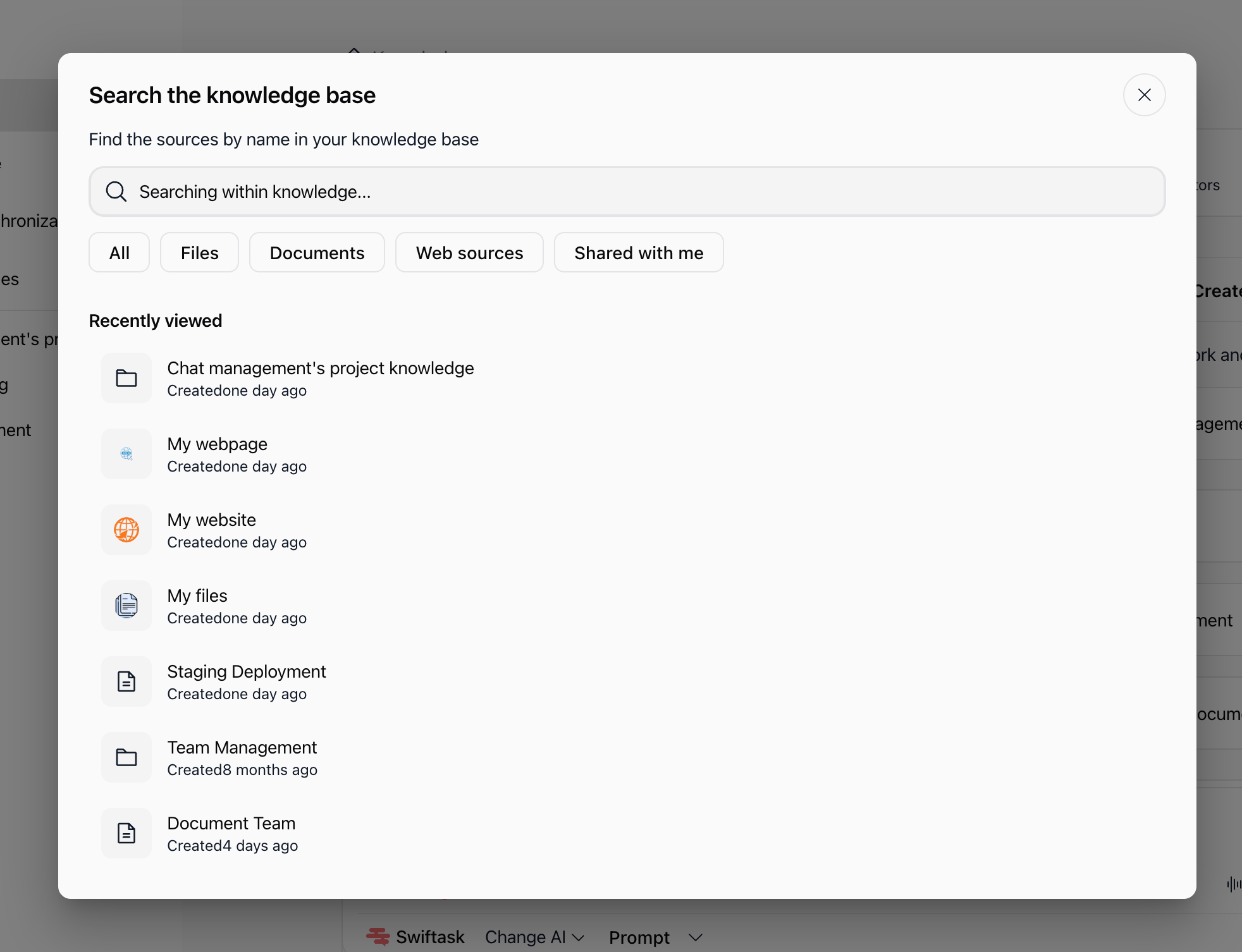
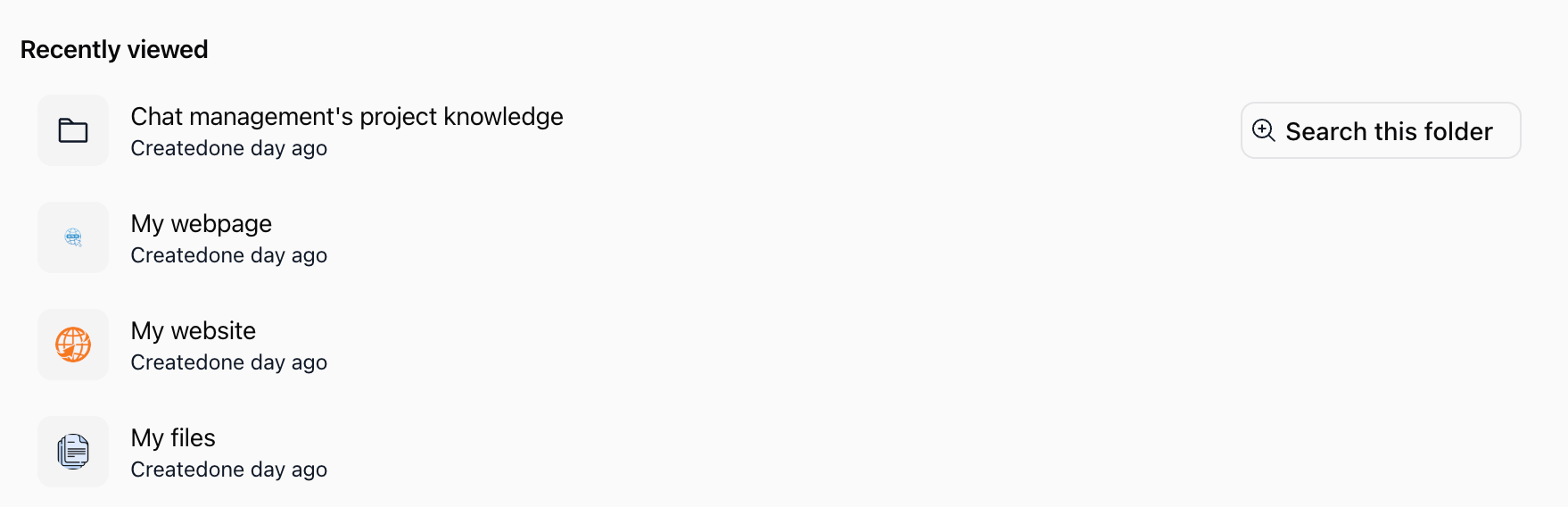
Click the search bar at the top of the Knowledge page, located above your knowledge list. The search modal opens and immediately displays your Recently viewed folders, files, and documents.
Filtering search results
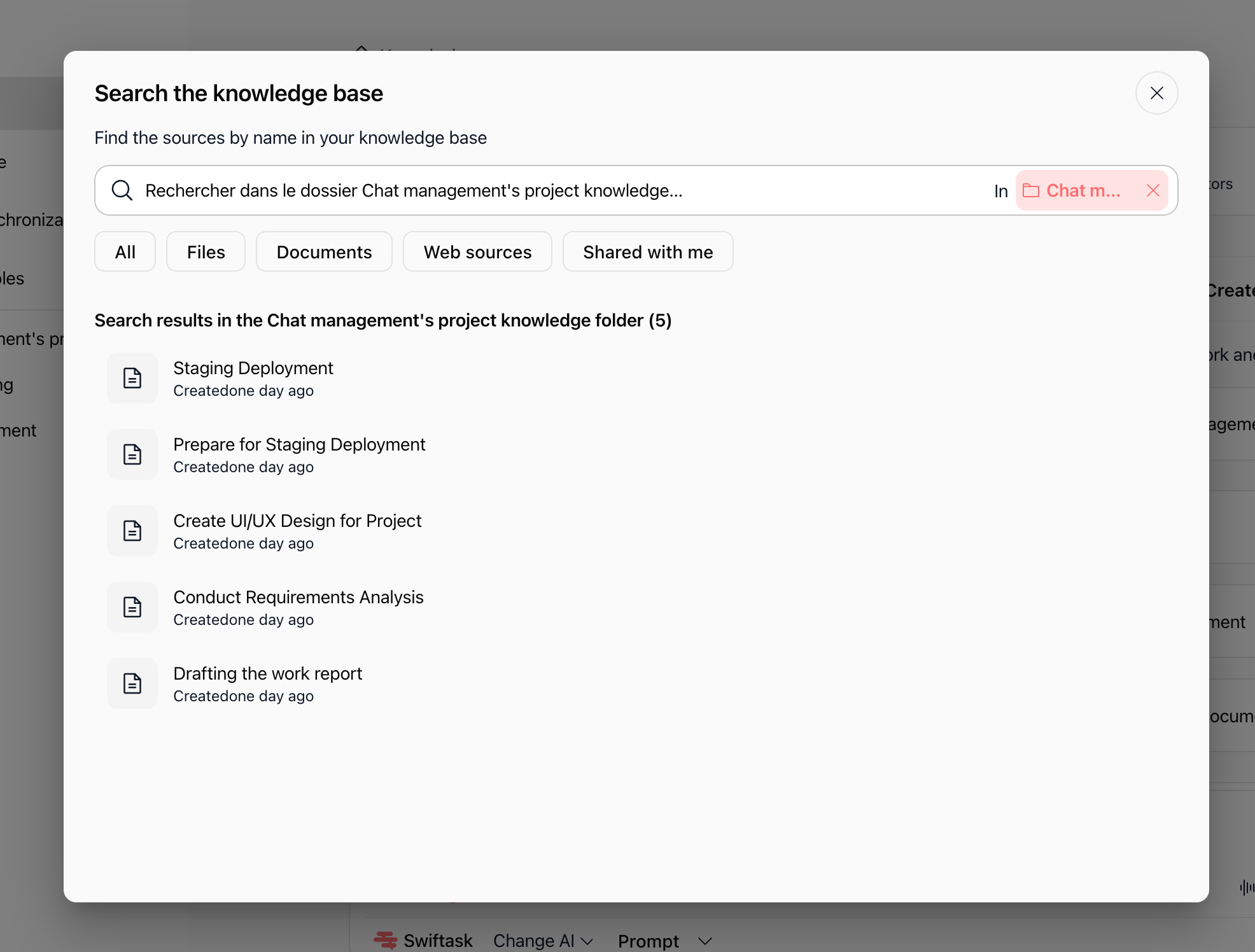
Type your keywords into the search field to find sources by name. You can filter results by content type using the filter chips:
All – Displays all matching items across your knowledge base.
Files – Restricts results to uploaded files such as PDFs, spreadsheets, and Word documents.
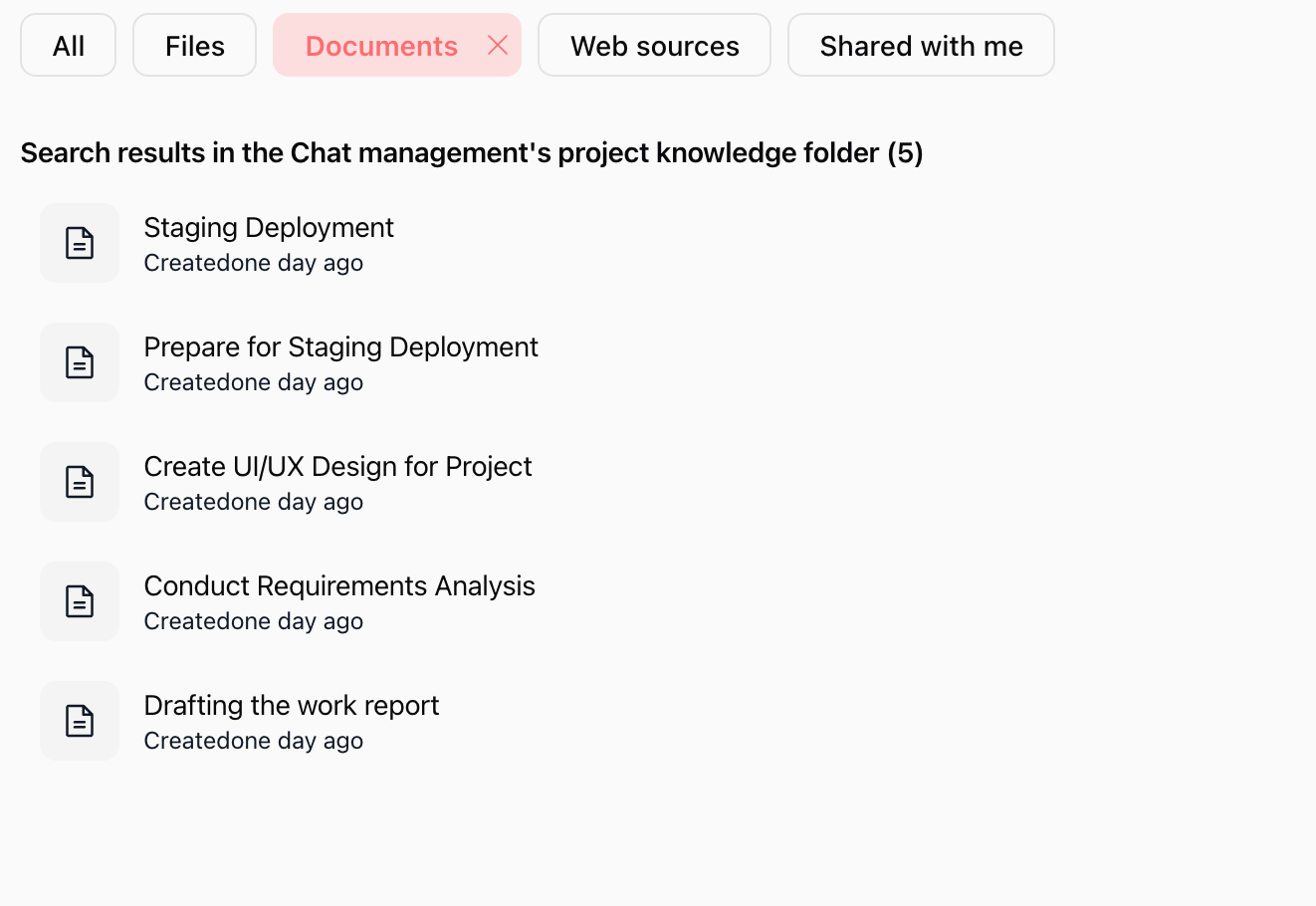
Documents – Restricts results to documents created natively within Swiftask.
Web sources – Displays imported websites, webpages, and sitemaps.
Shared with me – Shows only items shared with you by other team members.
Searching inside a specific folder
You can limit your search scope to a single folder:
Hover over any folder in the search list or under Recently viewed.
Click the Search this folder button on the right side of the folder row.
The search bar updates with a folder badge and displays all contents located inside that specific folder.
Select any filter chip (such as Documents) to further narrow down search results within that folder.
Practical use cases
Company onboarding hub: Store employee manuals, IT policies, and benefits documents in a shared folder. Connect the folder to an internal HR agent to answer employee questions with verified citations.
Product and engineering repository: Centralize API guides, release notes, and architecture diagrams. Allow technical support agents to retrieve precise troubleshooting steps instantly.
Cross-project resource sharing: Link a folder of brand assets and marketing guidelines to a project workspace so every project chat references the same materials automatically.
Tips & best practices
Structure with clear folder naming: Use descriptive folder names like Sales Playbooks or Q3 Client Deliverables so team members and agents identify contents easily.
Choose the right view for your workflow: Use Card view for visual identification of source types and List view when auditing large directories.
Keep source documents focused: Splitting large topics into smaller, dedicated documents improves semantic search retrieval and citation precision for AI agents.
Troubleshooting
Uploaded document not appearing in search:
Cause: The document is still being indexed or parsing encountered an unsupported format.
Fix: Check the index status icon on the document card; wait for the green checkmark before running queries.
Folder creation button disabled:
Cause: You may not have Create/Update permissions assigned for Knowledge base in your workspace role.
Fix: Contact your workspace Administrator or Owner to grant you Knowledge base management permissions.
Cannot see items under "Shared with me":
Cause: No teammate has shared specific folders or sources with your user account.
Fix: Have the folder owner open the folder's three-dot menu (
⋯), select Share folder, and add your account.
Additional resources
Knowledge base folders – Organize documents with multi-level nested folders
Use Knowledge – Deploy knowledge sources across Chat, Agents, and Projects
Import documents / files – Upload local files directly to your knowledge base
Import website / webpage – Crawl external sites and web pages
Create Document – Draft and format notes inside Swiftask
Import from Cloud (Google Drive, Dropbox, SharePoint) – Connect and sync cloud drives
Automatic synchronisation – Automate background refreshes for cloud sources
Knowledge table – Build structured databases for AI agents
Was this helpful?
Still need help? Ask the team