Authenticating in the desktop app
Written By Stanislas
Last updated 16 days ago
Overview
Authentication connects the Swiftask desktop app to your online workspace. Once signed in, all your agents, projects, documents, and meeting archives sync instantly to your computer.
Use this process after installing the app or whenever your corporate login session expires.
Prerequisites
Before signing in, make sure you have:
The Swiftask desktop app installed and open.
Your registered login credentials (email and password, Google account, or Microsoft account).
A workspace with SSO/SAML configured if your organization enforces single sign-on.
Step-by-step guide
1. Open the login screen
Launch the Swiftask desktop app on your computer.
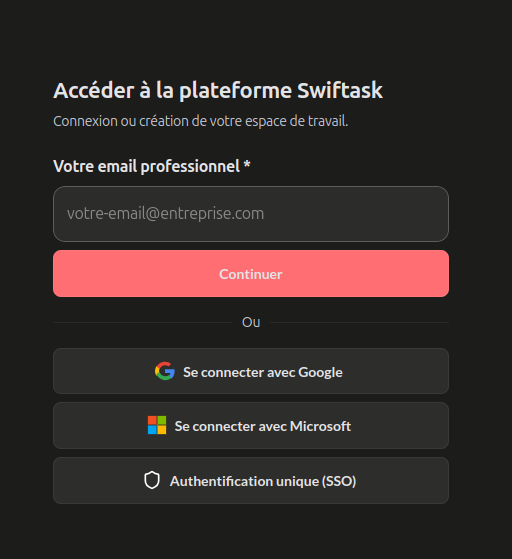
The initial authentication screen appears with available login options.
[Screenshot: Desktop app sign-in screen]
2. Select your authentication method
Option A: Email and password
Enter your registered email address and password.
Click Sign in.
Option B: Google or Microsoft OAuth
Click Continue with Google or Continue with Microsoft.
Complete authentication in the browser window and grant the requested session access.
Option C: Enterprise SAML SSO
Click Sign in with SSO.
Enter your company domain name.
Authenticate through your identity provider (such as Azure AD or Okta).
3. Access your workspace
After successful authentication, the desktop app loads your active workspace.
If you belong to multiple workspaces, click your profile icon in the sidebar to switch between them.
Practical use cases
Enterprise sign-in with corporate identity
An employee signs into the desktop app using single sign-on with Azure AD credentials, adhering to corporate access policies without needing a separate password.
Switching workspaces during client reviews
A consultant accesses multiple client environments by authenticating and switching workspaces directly within the desktop interface.
Tips & best practices
If your company enforces SAML SSO, ask your administrator for the exact domain slug required.
Do not share login credentials; each team member should maintain an individual account.
Stay signed in to enable background meeting detection without repeated authentication.
Troubleshooting
Login error or invalid credentials
Cause: Incorrect email or expired password.
Fix: Use the Forgot password option on the web app to reset your password, then attempt to sign in again.
SSO domain not found
Cause: Misspelled company domain or unconfigured SAML settings.
Fix: Confirm the domain name with your workspace administrator and ensure SSO is active in Workspace settings → SSO/SAML.
Additional resources
SSO/SAML – Setting up Azure AD SAML SSO for Swiftask.
Installing Swiftask desktop – Step-by-step installation instructions.
Was this helpful?
Still need help? Ask the team