Model selection
Written By Stanislas
Last updated 16 days ago
Overview
Model selection allows you to choose the underlying large language model (LLM) that powers your AI agent. You can configure a primary model, set up an automatic fallback model for uninterrupted uptime, and adjust core execution parameters like reasoning effort and temperature.
Selecting the right model balances intelligence, response speed, data privacy, and credit consumption for your specific business requirements.
Prerequisites
A Swiftask account on any active plan.
Permission to create or edit agents in your workspace (Admin, Owner, or Member with agent management access).
An existing agent or a new agent draft in configuration mode.
Step-by-step guide
1. Open the LLM configuration settings
Go to your agent configuration screen.
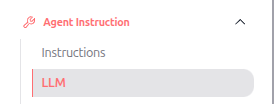
In the left navigation panel, click Agent Instruction to expand the section.
Select LLM.
2. Choose your primary LLM model
Under the LLM Model field, click the model selection dropdown to open the model library.
Browse models by category (such as Best for most tasks, Cost effective, Anthropic - Claude, OpenAI, OpenAI - Azure 🇪🇺, Bedrock 🇪🇺, or Scaleway hosting 🇪🇺), or use the search bar to locate a model by name.
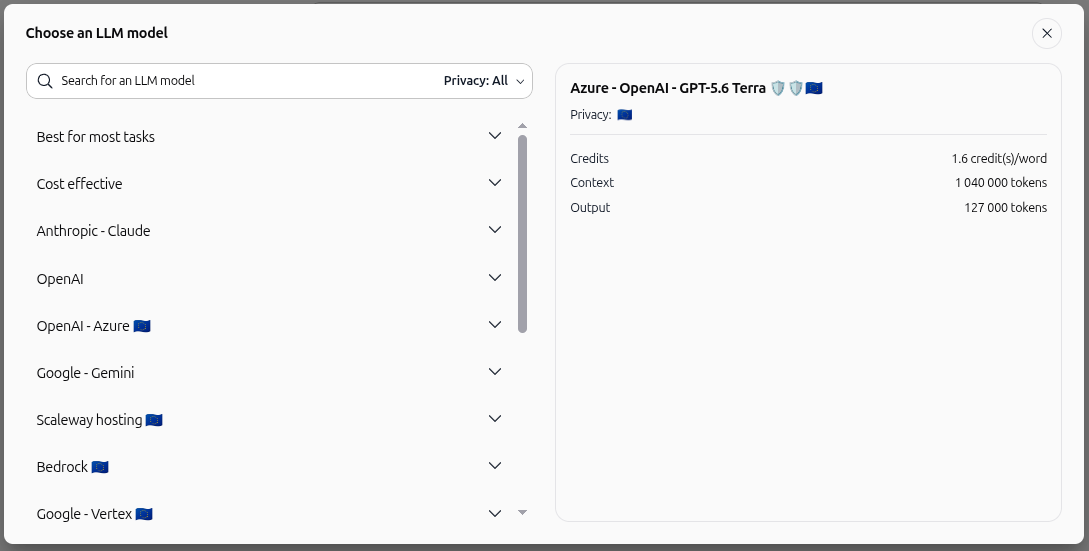
Review the model metrics in the right preview pane before confirming your selection:
Credits: The billing rate per word processed (e.g.,
1.6 credit(s)/word).Context: The maximum input context size in tokens (e.g.,
1 040 000 tokens).Output: The maximum completion length in tokens (e.g.,
127 000 tokens).
Click on your chosen model to set it as the primary LLM.
3. Filter models by privacy tier
To comply with data governance and regional compliance policies, filter models using the Privacy dropdown:
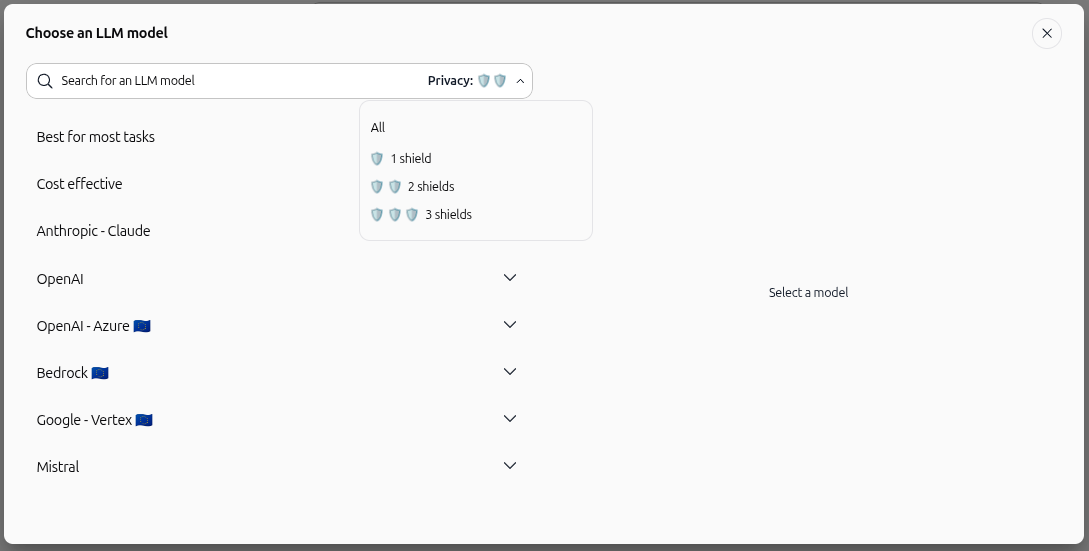
🛡️ 1 shield (Provider API): Requests are processed directly via the provider's standard API endpoints under standard zero-data-retention agreements.
🛡️🛡️ 2 shields (European cloud hosting): Models hosted within the European Union on infrastructure like AWS Bedrock EU or Azure EU to guarantee GDPR and data residency compliance.
🛡️🛡️🛡️ 3 shields (French sovereign cloud): Models hosted on Scaleway infrastructure in France, providing sovereign hosting and strict data isolation for sensitive enterprise workflows.
4. Set up an optional fallback LLM
A fallback model guarantees service continuity if your primary model experiences rate limits, outages, or temporary provider issues.
Under Fallback LLM (in case of failure of the main LLM), click the dropdown menu.
Select a backup model from the list.
If you no longer require a fallback model, click Remove fallback LLM next to the field.
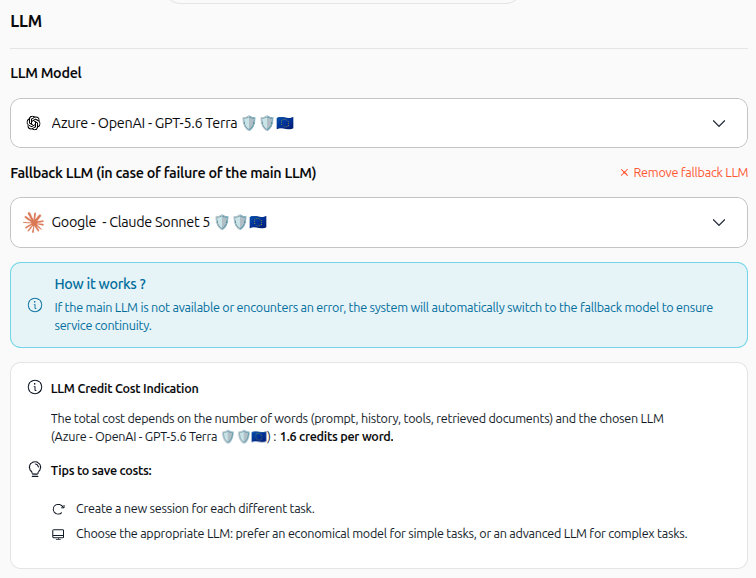
When an error occurs with the primary model, Swiftask automatically retries and executes the request using the fallback model without interrupting the user.
5. Adjust reasoning effort
When you select a primary model that supports extended thinking (such as Anthropic Claude reasoning models), the Reasoning effort control displays dynamically below the model picker.
Locate the Reasoning effort section.
Choose one of three analysis depths:
Low: Fast responses with minimal internal reasoning. Best for routine tasks.
Medium: Balanced thinking depth for standard business logic and multi-step reasoning.
High: Deep analytical evaluation before responding. Ideal for complex data extraction, logic verification, and coding.
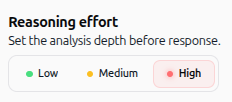
Note: Higher reasoning levels consume more tokens during the thinking phase, which increases credit usage per message.
6. Configure temperature
The temperature setting controls the balance between predictable precision and creative variety in responses.
Scroll to the Temperature section.
Drag the slider or type a decimal value between 0.0 and 1.0:
0.0 to 0.3 (Strict and deterministic): Produces consistent, factual, and repeatable answers with minimal deviation.
0.4 to 0.7 (Balanced): Provides natural conversational fluency while maintaining structured accuracy.
0.8 to 1.0 (Creative and varied): Encourages varied vocabulary, diverse perspectives, and imaginative phrasing.

Practical use cases
Sovereign legal and compliance assistant
Configuration: Primary model with 🛡️🛡️🛡️ 3 shields (Scaleway sovereign cloud), temperature set to 0.1.
Result: Strict regulatory compliance where sensitive company policies and contracts never leave sovereign French infrastructure, producing deterministic citations without hallucination.
Mission-critical customer support agent
Configuration: Fast primary model (e.g., cost-effective EU-hosted model) paired with an equivalent backup model under Fallback LLM, temperature set to 0.5.
Result: Instant, polite, and consistent customer replies with guaranteed zero downtime during external provider outages.
Complex financial analysis and forecasting agent
Configuration: Advanced reasoning model with Reasoning effort set to High, temperature set to 0.2.
Result: Deep mathematical and logical scrutiny across lengthy reports, ensuring accurate numerical deductions before delivering answers.
Tips & best practices
Match model capability to task scope: Avoid using high-cost models for simple keyword lookups or basic formatting. Use cost-effective models for high-volume routine operations.
Start new conversation sessions: Credit consumption scales with total words processed across prompts, conversation history, attached tools, and retrieved documents. Starting a new session resets the context history and reduces credit costs.
Lower temperature for tool-heavy agents: When your agent connects to external skills or APIs, lower the temperature (0.0 to 0.2) to ensure strict adherence to JSON parameters and tool invocation schemas.
Select complementary fallback models: Choose a fallback model from a different hosting provider or cloud vendor than your main model to prevent shared infrastructure failures.
Troubleshooting
Why does my agent frequently switch to the fallback LLM?
Cause: Your primary model provider might be experiencing temporary degraded latency, rate limit exhaustion, or regional network downtime.
Fix: Check your workspace credit balance and verify provider status. If issues persist on the main model, switch to an alternative provider in the same privacy tier.
Why is the reasoning effort setting not displayed?
Cause: The Reasoning effort section only appears for models that support extended thinking or chain-of-thought analysis.
Fix: Check your selected primary LLM. Select an extended thinking model (such as supported Anthropic Claude variants) to reveal the control.
Why are structured answers or tool calls returning irregular formats?
Cause: A high temperature value (above 0.7) introduces randomness, which can cause inconsistent formatting or invalid tool calling arguments.
Fix: Reduce the temperature to 0.2 or 0.0 to enforce strict formatting and reliable tool parameter generation.
Additional resources
Agent profile: Set your agent's identity, avatar, and core metadata.
Agent instructions settings: Define system prompts, operational rules, and expected agent workflows.
Best practices for optimizing Swiftask credit usage: Learn how context size, tool calls, and model rates impact your workspace balance.
Was this helpful?
Still need help? Ask the team